
Coconut Shell Activated Carbon
Steam-activated granular and powdered activated carbon made from 100% coconut shell in Indonesia, for gold recovery, water treatment, food processing and industrial purification.
Why Choose Us
Competitive Global Pricing
Efficient Indonesian manufacturing and export advantage
High Quality Coconut Carbon
Superior adsorption performance and low ash content
Reliable Export Logistics
Container-ready international shipping support
OEM & Private Label Available
Custom branding and packaging solutions for distributors
Coconut Shell Activated Carbon from Indonesia
INDUSTRIES WE SERVE :
Gold Mining (CIP/CIL)
Drinking & Wastewater Treatment
Food & Beverage
Air & Gas Purification
Chemical & Pharmaceutical
What is coconut shell activated carbon?
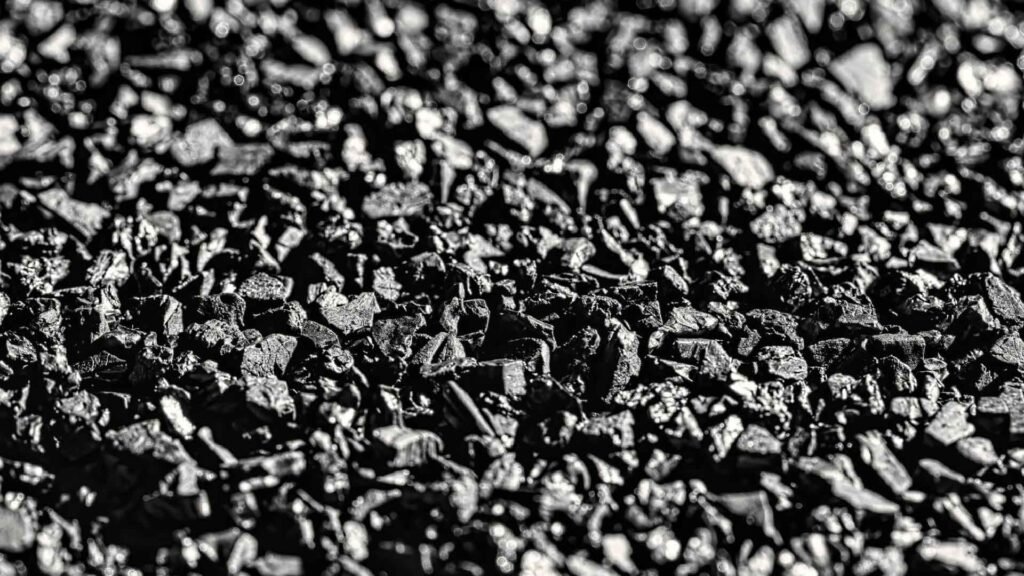
Coconut shell activated carbon is a porous carbon made by carbonising coconut shells and then activating the char with steam at high temperature. Activation opens a dense network of pores, so one gram of carbon offers a very large internal surface for adsorption. Coconut carbon is dominated by micropores, which makes it especially good at capturing small molecules: gold-cyanide complexes in CIP/CIL circuits, chlorine and organic compounds in water, and odours and volatile organics in air.
Compared with coal- or wood-based carbon, coconut shell carbon is harder, lower in ash and produces less dust. Those three properties are why gold mines and drinking-water plants usually specify it.
Independent lab results
An independent test by Carsurin in June 2026 on our steam-activated coconut shell carbon measured:
| Parameter | Result |
|---|---|
| Iodine number | 1,148 mg/g |
| Hardness | 97.96% |
| Ash | 1.11% |
| Moisture | 0.89% |
Every shipment comes with a certificate of analysis, so you can check each lot against your specification.
Grades and typical specifications
| Grade | Mesh | Main use | Iodine (mg/g) | Hardness | Ash |
|---|---|---|---|---|---|
| GAC 4×8 | 4 x 8 | Air and gas purification, high-flow water filters | 1,000–1,150 | min 95% | max 3–4% |
| GAC 6×12 | 6 x 12 | Gold recovery (CIP/CIL) | 1,050–1,200 | min 95% | max 3% |
| GAC 8×30 | 8 x 30 | Drinking water and wastewater treatment | 1,000–1,100 | min 95% | max 4% |
| GAC 30×60 | 30 x 60 | Fine filtration and cartridges | 1,000–1,100* | min 95%* | max 4%* |
| PAC | 200 / 325 | Decolourisation: sugar, MSG, cooking oil, water clarification | 800–1,100 | – | – |
*Typical values for GAC 30×60, confirmed per order. Iodine grades from 800 to 1,200 mg/g are available on request, and CTC activity can be specified instead of iodine.
Why steam activation matters
We activate with steam only. Chemical activation uses agents such as phosphoric acid or zinc chloride, which must be washed out and can leave residues. Steam-activated carbon has no activating chemicals to remove, which is why it is preferred for drinking water, food processing and gold recovery, where hardness and purity count.
Applications
- Gold recovery (CIP/CIL): GAC 6×12 with high hardness to limit carbon fines and gold losses.
- Water treatment: GAC 8×30 and 4×8 for chlorine, taste, odour and organics removal.
- Food and beverage: decolourisation and purification of sugar, syrups, edible oils and MSG.
- Powdered activated carbon (PAC): dosing into liquids for fast colour and odour removal.
- Air and gas purification: GAC 4×8 for odours, solvent vapours and exhaust gases.
Coconut shell vs coal-based activated carbon
| Property | Coconut shell | Coal-based |
|---|---|---|
| Hardness | High, low attrition | Lower, more fines |
| Pore structure | Mostly micropores | Mix of micro- and mesopores |
| Ash | Low (our test: 1.11%) | Usually higher |
| Raw material | Renewable coconut shell | Fossil coal |
| Best for | Gold recovery, drinking water, chlorine and VOCs | Larger molecules, some colour removal |
Supply and terms
- Production capacity: 200 MT per month.
- Minimum order: 1 x 20ft container (approx. 18 MT); trial orders at the regular price.
- Packaging: 25 kg PP bags or jumbo bags; private label available.
- Ports of loading: Tanjung Priok, Tanjung Emas or Tanjung Perak.
- Terms: FOB or CIF; T/T, advance payment or L/C at sight.
- Lead time: ready stock for standard grades; custom specifications in 1–4 weeks.
Read more about us as an activated carbon supplier in Indonesia, see what drives activated carbon prices, or request a quote.
Manufacturing and quality evidence
We make this carbon at our own factory in Tegalluar, Bandung Regency, West Java. You can follow each production step, from incoming coconut shell charcoal through washing, steam activation, 14-day weathering and screening, on our manufacturing process page. What each test measures, which ASTM method is used and our independent results are explained on Quality Control & Laboratory Testing, and the full lab reports and factory audit are on our certification page.
Related guides: is activated carbon the same as activated charcoal? and coconut shell vs coal-based activated carbon.
Frequently asked questions
What is coconut shell activated carbon used for?
Mainly gold recovery in CIP/CIL plants, drinking water and wastewater filtration, food and beverage decolourisation, and air and gas purification.
Is coconut shell activated carbon better than coal-based carbon?
For gold recovery and drinking water, usually yes: it is harder, lower in ash and richer in micropores. Coal-based carbon can perform better on very large molecules.
What iodine number does your coconut shell carbon have?
Standard grades range from 1,000 to 1,200 mg/g, and an independent Carsurin test in June 2026 measured 1,148 mg/g. Grades from 800 mg/g are available for price-sensitive uses.
Is your carbon steam-activated or chemically activated?
Steam-activated. No chemical activating agents are used.
What is the minimum order quantity?
One 20ft container, approximately 18 MT. Trial orders are priced the same as regular orders.
Can I get a sample?
Yes, from 1 kg by air freight. The sample and courier costs are paid by the buyer.
Related: all grades and specifications · gold recovery · water treatment · powdered activated carbon · how to read a COA